

The Milt Zaslow award for 2013 in the Junior Division went to Catie Gast and Kerry Van Rees from the Matapeake Middle School in Stevensville who are pictured below on the left with their teacher, Jillian Ferris, and their exhibit. Their award was in the Group Exhibit category and was presented by Senator Mike Miller.

The National Cryptologic Museum will display their exhibit (with process paper and annotated bibliography) on Saturday, June 1 and Saturday, June 15, between 10 AM and 2 PM.
The following is their process paper for the exhibit:
The Navajo Code Talkers: Turning the Tide of World War II in the Pacific.
Why we chose this topic:
Unfortunately, the history of the United States is tainted with the suppression of its Native Americans. Yet the Navajo Nation stepped forward during World War II to help defend our country. When we first read about the Navajo Code Talkers, we found the accounts riveting, and began to believe their contributions should be considered a turning point in the war. We chose this topic because we were not aware of how important they were to WWII, and others may not realize it either.
How we conducted our research:
We researched the Code Talkers in school using the internet and the school library, where we identified several useful books and websites. Our families helped us visit the public library to check out more books and a History Channel documentary on unsung heroes of World War II. We took notes on the documentary and used portions of the books when preparing the annotated bibliography and exhibit. Reading the personal accounts and finding photographs from the primary resources we found helped us finalize the proposal for our project. Completing the history day project proposal for our teacher helped guide our research to see what errors we had, what types of sources to use, and what changes and corrections we needed to make.
How we created and developed our exhibit:
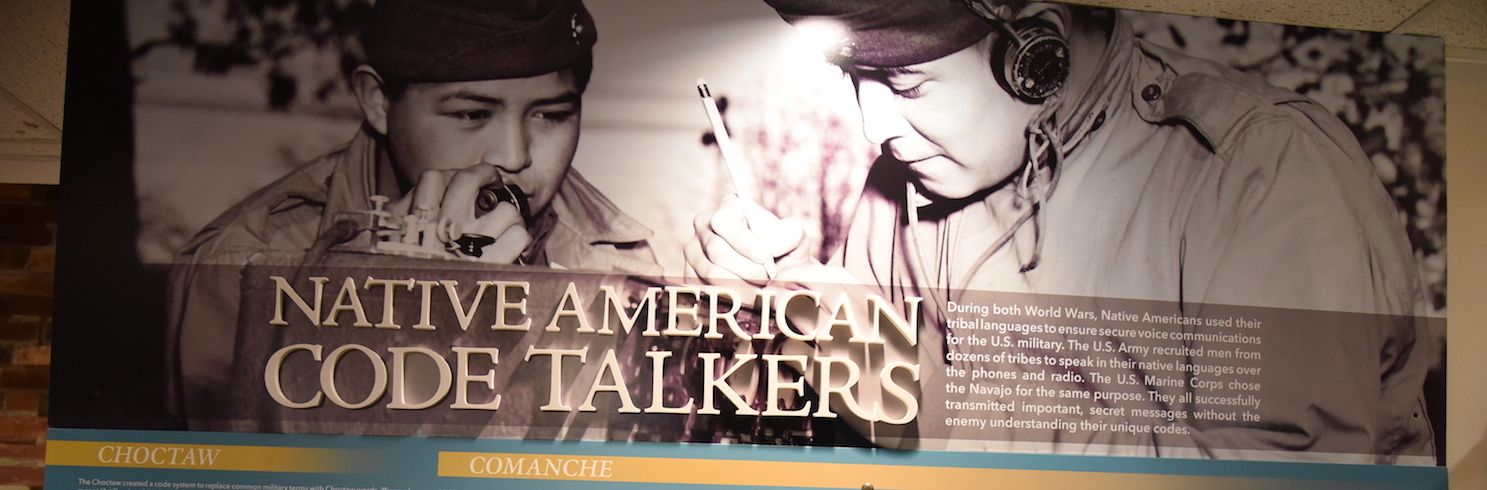
From our research we identified major events that we included in our exhibit, such as the battle of Iwo Jima and the creation of the code. We also added some pictures of the Navajo Code Talkers, while they were in training and on the battle field. Additionally, we created an interactive game “Match the Code.” This game challenges the player to match Navajo and English words to the pictures. And shows the difficulty of the code for the “Talkers” and for the potential “breakers,” so the player can leave with a better understanding of the pivotal role the Code Talkers had during World War II.
How the project relates to the theme:
The Navajo Code Talkers were a turning point in World War II because their unbreakable code saved lives and helped end the war. Before the Navajo code was used, Japanese forces had broken all the previous U.S. codes. A Navajo coded message could be sent, translated, and be replied to in about 30 seconds, while earlier codes took much longer. Because of the Navajo Code Talkers, the U.S. captured Iwo Jima, and eventually won the war. This had a huge impact on turning the tide in WWII.
The winners of the Milt Zaslow Award in the Senior Division went to Dara Wais, Luke Sullivan, Gabriel Grell, and Noah Gamper. They are shown below, in the preceding order, along with their exhibit which will be on display at the National Cryptologic Museum on Saturday, June 1 and Saturday, June 15, between 10 AM and 2 PM.

They attend Baltimore Polytechnic Institute and their teacher is Eric Green. Their subject was: The Effect of the Navajo Code Talkers on U.S.-Native American Relations after World War II.
The following is their process paper:
A visit to a restaurant near Mesa Verde, New Mexico happened to have a Navajo code talker exhibit, which piqued the interest of one of our group members in the Navajo Code. A wampaum belt from Noah’s grandfather, who fought in WWII, prompted his interest in both the war and the history of Native Americans. Together these interests drove our group to study and create a project about the Navajo Code Talkers.
Our search was mostly online with a few book sources. We found out what battles they made a significant effect on as well as the methods they used during these battles. We found a wealth of primary source photographs online of the code talkers in action. We also used journals of the code talkers. We did extensive research online for most of the sources. All of these sources helped us to understand how the code talkers affected the turn of the war.
We chose the exhibit because we thought it would be the best way to present the Navajo Code Talkers. It is easy to display our primary sources of documents, letters, and pictures. The essay did not fit our topic well because of the type of evidence we collected. When we decided on the code talkers, we thought making an exhibit would best display what happened on the battlefield. Our exhibit shows the jungle-like terrain of the Battle of Iwo Jima, with several Navajo Indians transmitting messages through radio while the US Marines are fighting the Japanese on the battlefield.
The Navajo Indians involvement in WWII proved to be a turning point of the war and for U.S. Native American relations by assisting the U.S. in defeating Japan, creating a code for Allied radio traffic, compiling a remarkable war record, and receiving national and international recognition. Before the World War II, the U.S. government treated the Navajo and many other tribes unfairly. They were pushed off their lands and forced to walk at gunpoint from present-day Arizona to New Mexico. The Navajo’s relation with the government during WWII was the first major positive relation between the U.S. and Native Americans since white man came to America. Not only was this a positive relation, it was also a turning point in WWII because the radio signals could not be intercepted or interrupted by the Japanese.
In the battle of Iwo Jima, the code talkers sent over 800 messages, which was pivotal in the battle. The Navajo also made significant impacts on the Battle of Guadalcanal and the Battle of Okinawa Island, which both ended in U.S. victories. Almost 30 years after the war, President Ronald Reagan praised their bravery, even making a memorial for their efforts. Their involvement in WWII was not only a turning point for the war but also for U.S.-Native American relations in general. They have allowed Native American tribes to build relations with the U.S. government and gain social attention.
A hitherto unknown variant of the German cipher machine Enigma has appeared on display at the Bloomfield Museum in Jerusalem, Israel. The machine, originally fabricated during WW2, has had its original German keyboard, lamp panel, wheels and minor labels converted to the Hebrew alphabet while curiously, given the Israeli anathema to all things associated with Nazi Germany, retaining the original German language instructional placard inside the machine's lid (photo on the right below). The serial number of the Enigma and its wheels are at the time of writing, undetermined. The machine is said to be the property of the Israeli Army.
There is an article in the Times of Israel about the machine but the one depicted in the article is Bletchley Park's Abwehr Enigma G-312.

Images courtesy Nathan Zeldes
A world-wide vote, conducted on the Internet, to determine the 'Greatest British Innovation of the 20th Century' has been won by Alan Turing's work that led to his theoretical Universal Machine, which in turn pioneered the Computer Age. Turing garnered eighteen percent of the overall vote while the close runner-up, with seventeen percent, was the UK's revolutionary car design: the Mini.
Even though 2012 was the Turing Year, he continues to be honored and his story told. Visit this UK web site where you will find all of the events that have taken place thus far this year and those scheduled for the balance of the year.
In late February Marty Mulligan, the President and CEO of Rohde & Schwarz Federal Systems, Inc. visited the National Cryptologic Museum to participate in a ceremonial event where he presented to Dick Schaeffer and Orville Lewis, the President and Vice President of the Museum's Foundation, respectively, a donation to assist the Foundation's efforts to create displays to educate visitors and academia on the historical successes in American Cryptology, a proud record of which extends back for more than two centuries.
Mr. Mulligan and his staff had visited the Museum late last year and were impressed at the Museum displays and the stories which accompanied each of the exhibits. Reflecting on the opportunities to assist in informing the public and academia, this group decided they would make a monetary contribution to assist in this effort.

Orville Lewis, Marty Mulligan and Dick Schaeffer
Founder, past President and Chairman of the Board of the NCMF and Phoenix Society Distinguished Member, John E. Morrison, 94, a 40-year resident of Davidsonville, MD, died on January 11. 2013 at his home. He was born on April 20, 1918 in Baltimore and graduated from the University of Baltimore in 1939 with a Juris Doctor degree. He was graduated from the Air Command and Staff College in 1949 and from the Air War College in 1959.

Gen. Morrison was a member of the Board of Directors of the National Historical Intelligence Museum; founder, president and Chairman of the Board of the National Cryptologic Museum Foundation; and a member of the Joint Military Intelligence College Foundation Board.
Maj Gen Morrison's accomplishments were many and varied
but two of General Morrison's proudest accomplishments were the creation of the NSA's National SIGINT Operations Center and his co-sponsorship of the AKA Smart (All Kids are Smart) program that introduced cryptology to local school curriculums. Read his biography at the USAF website and read about his accomplishments in the article written for his induction into the Cryptologic Hall of Honor by visiting the NSA website.
General Morrison's family would appreciate memorial contributions to his favorite charity, the National Cryptologic Museum Foundation, where his name will be placed in the NCMF In Memoriam Registry. You cn make a donation securely on line or make a check out to NCMF and mail to NCMF, POB 1682, Ft. Meade, MD 20755.
A Bletchley Park codebreaker, Raymond Roberts, who has been appointed Member of the Most Excellent Order of the British Empire (MBE) in the New Year Honours said he still hopes his whole team of nine will one day be recognized. He noted that three of his team made significant contributions: Alan Turing who broke the naval Enigma; Bill Tutte who broke the Tunny system to help shorten the war; and Tommy Flowers, who designed and built the Colossus, which sped up some stages of the breaking of Tunny traffic
Raymond "Jerry" Roberts, 92, sole survivor ot the team, receives the honour for services to the WWII decryption centre and to codebreaking.
Mr Roberts, of Hampshire, was among four founder members of the Testery section tasked with breaking the German High Command's Tunny code.
The decrypts are credited with helping shorten the war by at least two years.
Go to BBC News for more information.
On 26 October the NCMF held a ceremony to honor Richard L. Bernard as a Patron of the Foundation. In recognition of this membership level, Mr. Bernard's name was inscribed on the NCMF Patron Panel on the exhibit wall. At the ceremony Mr. Bernard was presented with the NCMF Commemorative Coin Recognition Award and an Honoring the NSA Directors' plaque as tokens of the Foundation's appreciation. Members of the Foundation and colleagues of Mr. Bernard from the NSA Center for Cryptologic History (CCH) attended. A reception followed in the Sigaba Room. Mr. Bernard had a long career at NSA and in the mid 80s was Chief of DEFSMAC. His career focus was ELINT and he is the author of two NSA published histories on DEFSMAC and ELINT written during his historian tenure at CCH.
Pictured below are: (front) Dick Bernard, John O'Hara, Mary Faletto, Gene Becker, (back) Bill Kevtkas, Ed Jacobs, Mike Warner, Dave Hatch, Bob Hunt and Orville Lewis

The Central Intelligence Agency recently launched an enhanced and redesigned online gallery to highlight the Agency’s museum and its holdings. The new section has a more modern look, improved navigation, an interactive timeline, new videos, descriptions of an additional 100 artifacts and expanded access to the Agency’s historical collections.
On July 13, 2012, His Royal Highness Prince Charles, Prince of Wales, unveiled a plaque at the National Memorial Arboretum which reads "To commemorate all those British and Allied personnel whose work in Signals Intelligence and Communications Security has supported the British Government in war and peace since 1914."

John Silcock was privileged to be invited to the ceremony and was introduced, as part of a small group of retirees which also included Michael Canning, to Prince Charles. Also present at the ceremony were eight of the nine living Directors (Brian Tovey couldn't be present), two of the surviving Bletchley Park-ers, Sir Arthur (Bill) Bonsall and Jimmy Pollard, several Service and civilian people from past and present field sites, representatives of sister British security and intelligence agencies, some current members of staff, and representatives of the US, Australian, Canadian and New Zealand governments.
Due to the weather conditions, Prince Charles unveiled a plaque, with the same wording as on the actual memorial, in the Chapel of the National Memorial Arboretum and was introduced to the past Directors, all, of course, Knights of the Realm.
For more details visit the GCHQ web site.
Submitted by John Silcock
The recent election for new members of the NCMF Board of Directors resulted in the selection of Whitfield Diffie, Elonka Dunin, Karl Gumtow, and Glen Miranker. The bios of these individuals are provided below. These individuals replaced Joan Dempsey, Robert Fitch, Arthur Money, and Rick Knop.
Whitfield Diffie is Vice President for Information Security at ICANN, the
Internet Corporation for Assigned Names and Numbers, Chief Cryptographer of
Revere Security, and Visiting Scholar in the Center for International Security
and Cooperation at Stanford University.
Diffie began his career in security as the inventor of the concept of public
key cryptography, which underlies the security of internet commerce. He has
made fundamental contributions to many aspects of secure communications and was instrumental in the rise of a public cryptographic research community.
In the 1990s he turned his attention to public policy and played a key role in opposing
government key-escrow proposals and restrictive regulations on the export of
products incorporating cryptography.
Diffie recently retired from his position as Chief Security Officer at Sun Microsystems and is now studying the impact of web services and grid computing on security and intelligence.
Prior to assuming his position at Sun, Diffie was Manager of Secure Systems research at Northern Telecom throughout the 1980s.
Diffie is a fellow of the Marconi Foundation, fellow of the Computer History Museum, and an inductee of the National Inventors Hall of Fame. He is the recipient of the National Computer Systems Security Award given jointly by the National Institute of Standards and Technology and the National Security Agency, the Levy prize of the Franklin institute, and other awards. His work and career are treated at length in the book Crypto by Steven Levy.

Elonka Dunin is General Manager of Simutronics, a leading developer of online multiplayer games, such as Game of the Year CyberStrike; and GemStone, the longest-running such game in the world.
Elonka studiedAstronomy at UCLA and then joined the United States Air Force. She was stationed at RAF Mildenhall in the United Kingdom, and Beale Air Force Base in California, where she worked on the SR-71 and U-2 reconnaissance aircraft.
Her lifelong interest in cryptography became public when in 2000 she was awarded a prize for being the first person to crack the PhreakNIC Code, created by the hacker group se2600.
Elonka is co-founder and co-leader of a group of cryptographers that is working on the codes of the famous Kryptos sculpture at CIA Headquarters, and led an international team that cracked the related KGB Cyrillic Projector Cipher.
She maintains a list of the world’s most famous unsolved ciphers on her web site and in 2006, published The Mammoth Book of Secret Codes and Cryptograms. In 2009, author Dan Brown honored Elonka by naming a character after her in his Da Vinci Code sequel, The Lost Symbol (the character "Nola Kaye" is an anagrammed form of "Elonka").

Karl is the Chief Executive Officer and founder of CyberPoint International, a cyber-security focused company delivering innovative, leading-edge products, solutions and services to customers worldwide. He is responsible for the overall strategic direction and leadership of CyberPoint and its subsidiaries.
Throughout his career, Karl has been dedicated to advancing the discipline of cyber security. His vision and business perspectives are the product of more than 20 years of working at all levels of the commercial and federal security communities. He is relied upon for his deep technical expertise in cyber security, as well as his experience leading organizations through some of the most complex, challenging and mission critical problems in this rapidly evolving field.
Karl has experience directing large engineering organizations, led numerous programs and initiatives related to security technologies, and developed innovative business strategies for both large and small enterprises.
Prior to founding CyberPoint, Karl served as the Vice President and Director, Intelligence and Space business unit of SRA. He also served as a Senior Vice President and then Chief Operating Officer of RABA Technologies, LLC, which was acquired by SRA in October 2006.
Karl’s passion for cyber security is equaled only by his commitment to giving back to the community. He is always working to find new ways to help educate, mentor and ensure the success of those in the communities in which he lives and works. From pioneering new ways to help school children learn about technology, to sharing his time and expertise with government and business leaders, he is always looking for opportunities to give back.
Karl holds a Master’s of Science in Electrical Engineering (MSEE) from Johns Hopkins University and a Bachelor’s of Science in Electrical Engineering (BSEE) from George Washington University. He is also the Chairman of the Board of Directors of the Security Technology Institute.
Glen Miranker earned his Bachelor of Science degree (sum cum laude) in Computer Science from Yale University, in 1975. He went on to earn his Master of Science and Doctor of Philosophy in Computer Science from the Massachusetts Institute of Technology in 1980. He was supported in his studies at M.I.T. as a fellow of the John and Fanny Hertz Foundation.
Upon graduation, Miranker went to the IBM Thomas J. Watson Research Center (Yorktown Heights, N.Y.) were he worked principally on special purpose machine architectures, and also held an appointment as an adjunct professor at Columbia University.
At Columbia, he taught graduate courses in VLSI design.
In May of 1981, Miranker and his wife Cathy Miranker, relocated to the Bay Area, where he joined a start up company, Valid Logic Systems (Sunnyvale) as employee number five.
Valid successfully went public in 1984. While at Valid, he held an adjunct appointment at University of California, Berkeley, where he taught on various topics in Computer Aided Design.
Miranker’s professional life continued through a series of Silicon Valley startups, but culminated with his being invited to join Apple Computer by Steve Jobs, in 1996. There, for most of his tenure he ran all of hardware development at Apple, except for Industrial Design and Engineering Design Services departments. In 2004, he became Apple’s Chief Technology Officer (Hardware) and retired in 2005.
Miranker now concentrates on his non-high-tech interests, which include, book collecting, and the history of cryptography. He has served on a number of boards and advisory panels including: The Newberry Library (Chicago); The Toronto Reference Library (Toronto); The Ransome Library (University of Texas, Austin); The Houghton Library at Harvard College; Rosalind Russell Arthritis Foundation
Miranker was born in New York, NY. He grew up principally in Ossining, NY., though as a he was a boy, his family lived (for a year each time) in Zurich, Los Angeles, Jerusalem, and Paris. He now lives in San Francisco, with his wife Cathy. They have two daughters, one working in Manhattan, and one at University in Washington, DC.
Earlier this year Dr. Edmund O. Schweitzer, III, donated $100,000 to the NCMF. This donation resulted from a 2010 visit to the NCM at which time he was introduced to the work of the NCMF. A ceremony commemorating his generous donation was held on 15 March. Some photographs from the event are provided below.
Dr. Schweitzer was born in Evanston, Illinois, where he followed in the footsteps of his father and grandfather and became an electrical engineer and inventor. He graduated with a BS in Electrical Engineering from Purdue University in 1968. From 1968-1973 he was assigned to NSA as an ELINT analyst on strategic radar systems. He returned to Purdue under NSA sponsorship in 1970 to finish his Masters degree. He spent 1971-1973 at NSA planning and managing ELINT collection and data processing systems.
In 1973 Dr. Schweitzer moved to California for a year, and then attended Washington State University to pursue a PhD in electrical engineering. His dissertation applied microprocessor technology and digital signal processing to the protection of electric power systems. Upon graduating in 1977 he joined the electrical engineering faculty of Ohio University. In 1979, he returned to Washington State University, this time as a faculty member in electrical engineering. In 1984 he founded Schweitzer Engineering Laboratories (SEL) in Pullman and invented the world’s first fully digital protective relay for electric power systems. Today, SEL serves over 140 countries making electric power safer, more reliable, and more economical. Born "a teacher" Dr. Schweitzer continues to support scholarships, professorships, internships, public and private schools, and universities and colleges throughout the world, including the Palouse Discovery Science Center in Pullman, Washington which provides hands-on science and learning experiences to people of all ages.
From a very early age Dr. Schweitzer had an interest in cryptologic history. In 2010, during a visit to the Washington, D.C. area, Dr. Schweitzer became reacquainted with his former NSA supervisor, Mr. Richard Bernard, who provided a tour of the National Cryptologic Museum and introduced him to the work of the Foundation. Dr. Schweitzer believes the museum honors the many people who have kept us safe thru their diligence and silence, and provides a way to share the vital roles of signals intelligence, once time and judgment allow.
In 1994 SEL, Inc. became a 100% employee-owned company that now employs over 3,000 people worldwide. Dr. Schweitzer is the author of over 70 professional papers and holds the patents to 30 inventions.
Dr. Edmund O. Schweitzer and his wife, Mrs. Beatriz Schweitzer

Dr. Schweitzer's Executive Assistant, Ms. Adina Bielenberg, Dr. Schweitzer's friend and colleague, Mr. Richard Bernard, Mrs. Beatriz Schweitzer, Gene Becker, and Dr. Schweitzer.
Photos by John Garcia
The NCMF members news is only available to Active Members of the NCMF. Currently available are Minutes from past Board of Directors and Executive Committee meetings as well as the full text of the recently signed MOU between NSA and the NCMF.
To access current and historical news, log into Members Only, click on Member News and scroll down to the News Archives where you will see all news items that are available. An alternative is to log into Members Only, scroll down to the Archives and do a search on the subject you are interested in.
- Last Updated - 5/20/2013
-Rare German book on Cryptology Acquired
-MD History Day & Zaslow Award,Junior Division
-MD History Day & Zaslow Award, Senior Division
-WWII POW Coded Letters Solved
-5/31/13 Spy Cruise on the Queen Mary II
-6/7/13-12th Annual Eagle Alliance Golf Tournament
Follow us on