


NCF Beginnings
The Foundation’s History Begins with the National Cryptologic Museum
The story starts before 1996. Discover how two visionary leaders safeguarded a growing cryptologic collection—and laid the foundation for what would become the NCF.
Remembering Our Beginnings….
In 1996 with the endorsement of then NSA Director, Lt. Gen. Ken Minihan, Maj. Gen. John E. Morrison Jr. founded the National Cryptologic Museum Foundation (NCMF) in the former SASA office in National Business Park, Annapolis Junction, MD. In 1997, Maj. Gen. Morrison arranged to have the office co-located with the Museum in the old Colony 7 Motel.
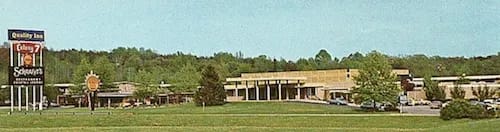
The Colony 7 Motel at Ft. Meade which became the home of the National Cryptologic Museum in 1993.
Retired colleagues of General Morrison’s formed the nucleus of the Foundation’s first board. These volunteers included Bob Rich, John Callahan, Guy Stephens, Joe Amato, Gene Becker, Milt Zaslow, and Bill Kvetkas. Later they were joined by the first women on the board, Ann Caracristi and Lee Hanna.
Pictured here is one of the first expanded board meetings, held in the Museum’s Magic Room circa 1998, and includes Directors, Officers, Executive Committee Chairs, NCMF Staff, and NSA representatives, Jack Ingram, Dave Hatch, and Jane Hudgins. See full list of those included in the photo below.
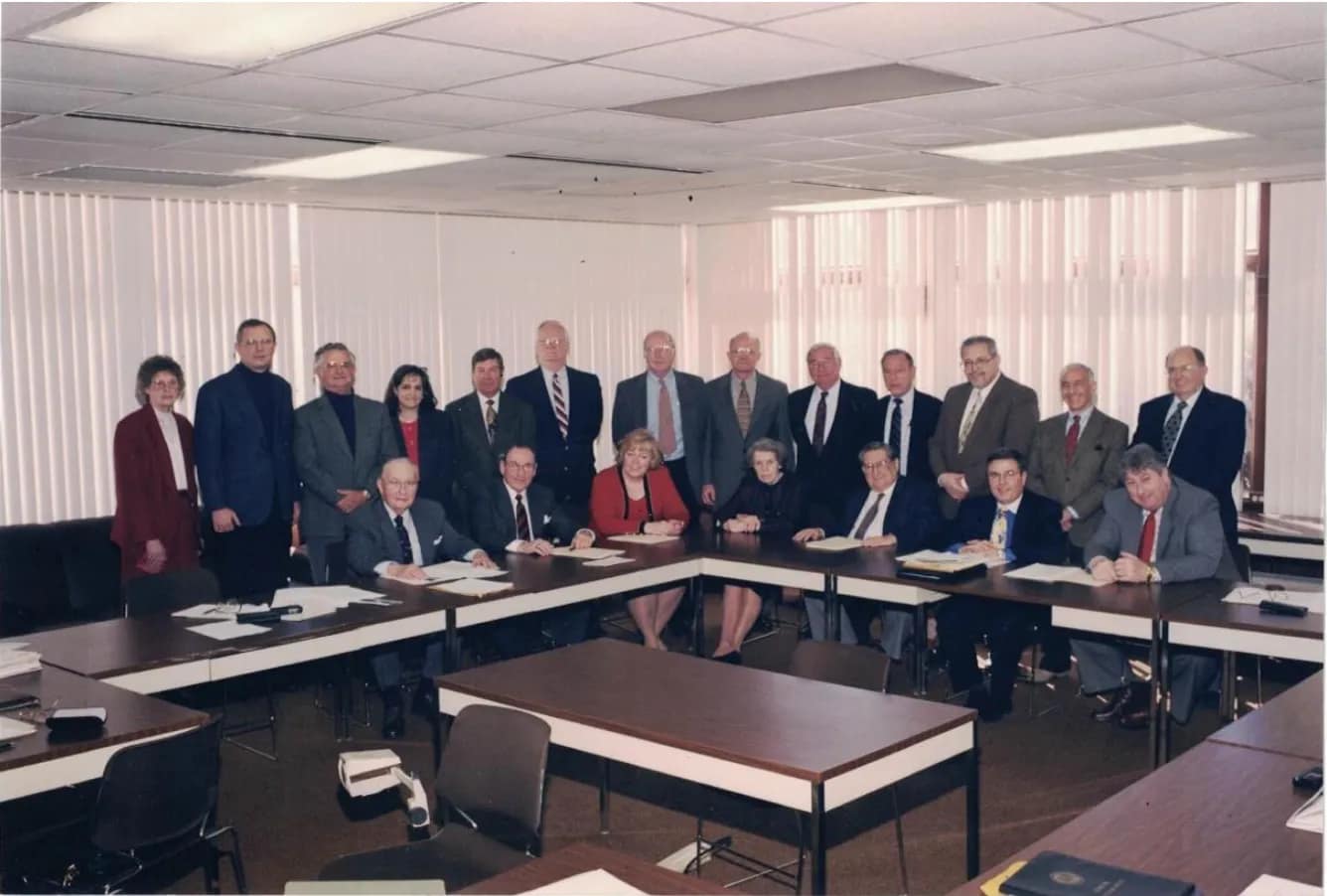
At the Table: Maj. Gen. John E. Morrison, Jr., President & Chairman of the Board; Robert Rich, BOD Director & Executive Vice President; Lee Ellen Hanna, BOD Director & Development Committee Co-Chair; Ann Caracristi, BOD Director; Milton Zaslow, Recognition Committee Chairman; Capt Fred Demech, USN (Ret), Public Affairs Chairman; and Fred Berghoff, committee member.
Standing: Beth Turner, Foundation Administrator; Jack Ingram, Museum Curator; James Boone, Acquisition Chair; Jane Hudgins, NSA Public Affairs; John Callahan, Treasurer; David Gaddy, BOD Director & LINK Editor; Len Moodispaw, General Counsel; Lt. Gen.James Clapper, Consultant; Joe Amato, BOD Director; Gene Becker, (Assistant to the President & Chairman); David Hatch, NSA Historian; David Kahn, BOD Director; William Arrington, Budget/Finance Officer
* Not Pictured: Bill Kvetkas, Treasurer; Jim Pryde, BOD Director; Dr. Robert Hermann, BOD Director; ADM William Studeman, BOD Director
The First Volunteers
Lt. Gen. Lincoln D. Faurer, USAF (Ret) former DIRNSA and second chairman of the NCMF Board of Directors, once remarked that it was insufficient to just say “thank you” to the cadre of volunteers that were the mainstay of the Foundation during its startup phase.
The original group of five who founded and chartered the organization, were former NSA retirees and senior officials, Major Gen. John E. Morrison, Jr., USAF (Ret), the Father of NSOC and the Deputy Director of NSA Operations; Bob Rich, former NSA Deputy Director; Milt Zaslow, former Chief of B Group; Jim Boone, former Deputy Director of R&D; and Bill Kvetkas, lawyer, CPA, and former programming and budget executive at NSA. They jointly foresaw the Museum as a future world-class institution due to three major development trends:
1 – They had witnessed the declassification and release of volumes of material, and saw an opportunity to make it available under one roof in a major research and study center,
2 – They believed the Museum served an important role in helping Intelligence professionals gain insights and lessons from past NSA successes and failures; and
3 – In the past decade, there had been an increasing public interest in cryptographic techniques.
These visionaries spent their careers in cryptologic service. A few had worked together since Arlington Hall Station, sharing in the exciting cryptologic successes of WWII. In addition, they had all worked in the Signals Intelligence and Information Assurance services during events such as the Suez Canal and Cuban missile crises, the capture of the USS Pueblo, and the EC-121 shootdown by North Korea during the Cold War. They had one common goal – to showcase NSA’s SIGINT, INFOSEC, ELINT, FISINT, and TELINT capabilities and their real-time value in times of crises like these.
Their work was tireless and their enthusiasm contagious.
In April 1996, they chartered the NCMF as a non-profit organization to support the Museum. By November, the first Board of Directors and executive committee chairmen for Acquisitions, Membership, Finance & Audit, Fund Raising, and Programs were nominated, and Bob Rich was selected as the Vice President and coordinator for the Executive Action Group.
One of the first achievements of this initial Board and Executive Committee leadership was the establishment of the Cryptologic Hall of Honor to pay special tribute to the pioneers of cryptology. This prestigious program was subsequently adopted by NSA in 1999 as the NSA/CSS Cryptologic Hall of Honor.
Jim Boone was the scholar among this group of pioneers, and the catalyst for a bigger and better space to maximize the new trends in cryptologic techniques and the rapidly changing field of computer technology. He used his close ties with the University of Maryland’s School of Architecture to commission the first construction plans for a new building.
In mid-1999, the Foundation submitted a proposal to NSA entitled, “Moving Toward a World-Class Museum.” Following its review, the NSA created a Senior Museum Steering Group to work with the NCMF Board of Directors to begin the serious planning of building a new National Cryptologic Museum. Frustrated by the slow moving gears of government, Jim left the team in 2002 to author a book entitled A Brief History of Cryptology. Prior to publication, he signed a contract with his publisher, the U.S. Naval Institute, to have all royalties donated to the Foundation.
In 2016, an agreement was reached with SECDEF to design, build, and operate the new Cyber Center for Education and Innovation, Home of the National Cryptologic Museum. The world-class center will include a revitalized museum, a research and rare books library, classrooms, and a conference center. In keeping with the Founding Fathers’ vision, it will provide unprecedented opportunities to share insights and knowledge to meet the nation’s critical need for next-generation cybersecurity.
NCF & NCM
From shared origins to ongoing partnership, the NCF and the National Cryptologic Museum work together to preserve the legacy of cryptology while inspiring the next generation to lead in cyber.

The National Cryptologic Museum Opens to the Public
In December 1993, the National Security Agency opened to the public a small museum of carefully preserved artifacts, books, and memorabilia, housed in a former motel just outside the perimeter of its tightly-secured headquarters complex at Fort George G. Meade, Maryland.
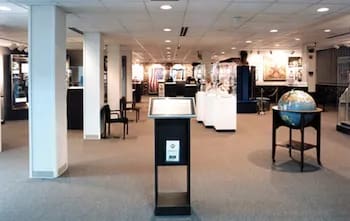
The NCM’s main exhibit room in 1993. Photo courtesy of Jack Ingram.
As part of a policy of new openness for the U.S. Intelligence Community, and with the concurrence of the Department of Defense, the Director, NSA, had approved a proposal to establish a National Cryptologic Museum (NCM). It would serve the professional education of the Agency’s civilian and military workforce, and, as a rare unclassified facility for the Agency, afford other government employees and representatives, as well as the general public, a “view behind the curtain” that had traditionally concealed the highly secret mission of the Agency. That mission…. to secure the confidential communications of the government and armed forces and to seek to derive intelligence from the communications of other governments.
The underlying message of the Museum is that America’s involvement in cryptology pre-dates her existence as an independent nation, and has evolved over nearly three centuries, occasionally emerging from behind the scenes during wars and national emergencies.
The Museum would have to be maintained, however, within allocated Agency resources and without competing against higher priority operational requirements. Still, modest as it was, the low-key ribbon-cutting was followed shortly by a growing stream of visitors, headed by foreign media representatives curious to see the marvelous Japanese “PURPLE” cryptosystem solved by American brainpower and examples of the mysterious German “ENIGMA” cipher machine, “broken” by the skills and ingenuity of Polish, French, British, and American cryptologists in World War II. The added attraction of a no-admission-fee quickly appealed to tourists and visitors and those promoting tourism.
A Supporting National Cryptologic Museum Foundation (NCMF) is Established
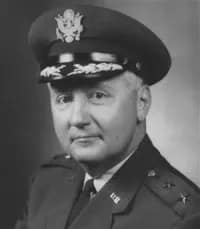
Major General John E. Morrison, Jr., USAF
The Museum, although little publicized, soon became a popular tourist attraction and a magnet for university students and scholars, as well as busloads of school children from elementary level through high school.
NSA recognized that something more than the limited support that it was able to provide to the Museum was needed.
Major General John E. Morrison, USAF (Ret), who had had a distinguished career in intelligence, with the endorsement of the then director of NSA, Lt. Gen. Ken Minihan, and assisted by others who shared his interests and operational experience, established the National Cryptologic Museum Foundation, Inc (NCMF). in April 1996, as a not-for-profit 501 (c)(3) organization. Its purpose was to support the Museum’s mission of educating the public about cryptology, commemorating its mostly unsung military and civilian heroes, and stimulating the minds of generations to come about the wonders of cryptology.
The board of directors selected to oversee the operations of the Foundation was composed of several former directors and deputy directors of NSA, a number of other senior military and civilian officers who had formerly served in the intelligence community, and several distinguished members from the private sector. The infrastructure of the Foundation, including its standing committees and operating procedures, was then developed by an Executive Action Committee chaired by the NCMF vice president.
Continued Growth
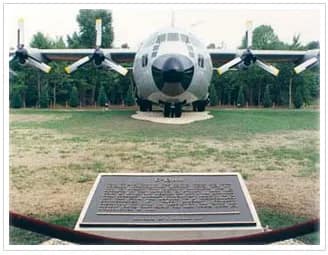
C-130 Dedication at National Vigilance Park
In September 1997, at the initiative of the U.S. Air Force, active and retired, and ably supported by the Foundation, a “National Vigilance Park” was dedicated near the Museum, its center-piece an actual C-130 aircraft, painted and displayed in commemoration of an electronic reconnaissance plane shot down over Soviet Armenia in September 1958, during the Cold War. Subsequently, Army and Navy aircraft, representative of their involvements in Cold War reconnaissance operations were added to the Park, expanding the Museum complex, which displays related interpretative displays and material.
In the spring of 1998, after months of planning, the Foundation’s newsletter, or “bulletin” (recalling the term used by H.O. Yardley’s “Black Chamber” and an early NSA “art form” for its products), was released as a hard-copy quarterly publication titled The Link.
Now Members and others who are interested can receive Foundation news via The Web Link e-letter. (See previous copies & subscribe.)
The original NCMF insignia carried on the masthead proclaimed involvement in cryptography and a respected heritage from the Army and Navy. A reminder of “old-fashioned” Morse code spelled out its initials and its message of longevity.
Foundation Support of the National Cryptologic Museum
Activities undertaken by the Foundation in support of the Museum have included the following:
- Direct acquisition of a considerable number of cryptologic artifacts for display in the Museum.
- Support for various Museum exhibits or displays.
- Support for advertising the Museum in the form of brochures describing the Museum’s content and the distribution of the brochures to local hotels, airports, and other places where tourists might be present.
- Acquisition for the NCM Library of the world-renowned David Kahn Collection of cryptologic literature. Advocacy of the Cryptologic Hall of Honor embraced by NSA and continued in an annual ceremony of induction of honored individuals.
- Financial support for the “Guide by Cell” system that allows visitors to obtain information about exhibits using their own cell phone.
- Establishment of an In Memoriam Registry to commemorate those who served in U.S. cryptology and at the same time raise funds in support of the Museum.
- Support of various events and activities that occur at the Museum.
Additional Foundation Activities
The Foundation also sponsors a continuing series of cryptologic programs featuring speakers on subjects of professional interest to its members, as well as an annual organizational meeting & symposium, which is scheduled to coincide with the biennial NSA Cryptologic History Symposium, also supported by the NCF.
Logo Evolution

Every symbol tells a story.
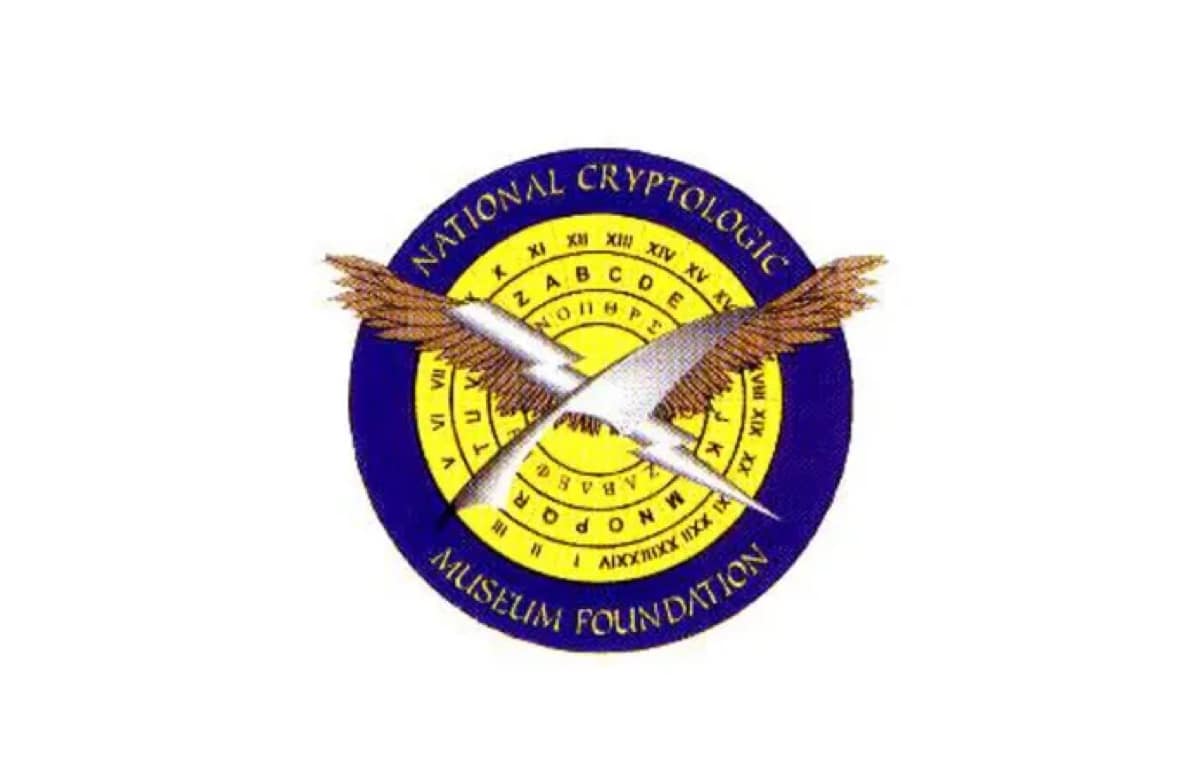
The Original NCMF Logo (1998)
A legacy rooted in military intelligence.
Designed by the NSA Graphics Department, the first logo for the National Cryptologic Museum Foundation (NCMF) featured a lightning bolt, quill, and cipher wheel. Together, these classic symbols embodied the spirit of military intelligence, education, and cryptologic history.
The Flag Logo (Early 2000s)
A patriotic bridge between past and present.
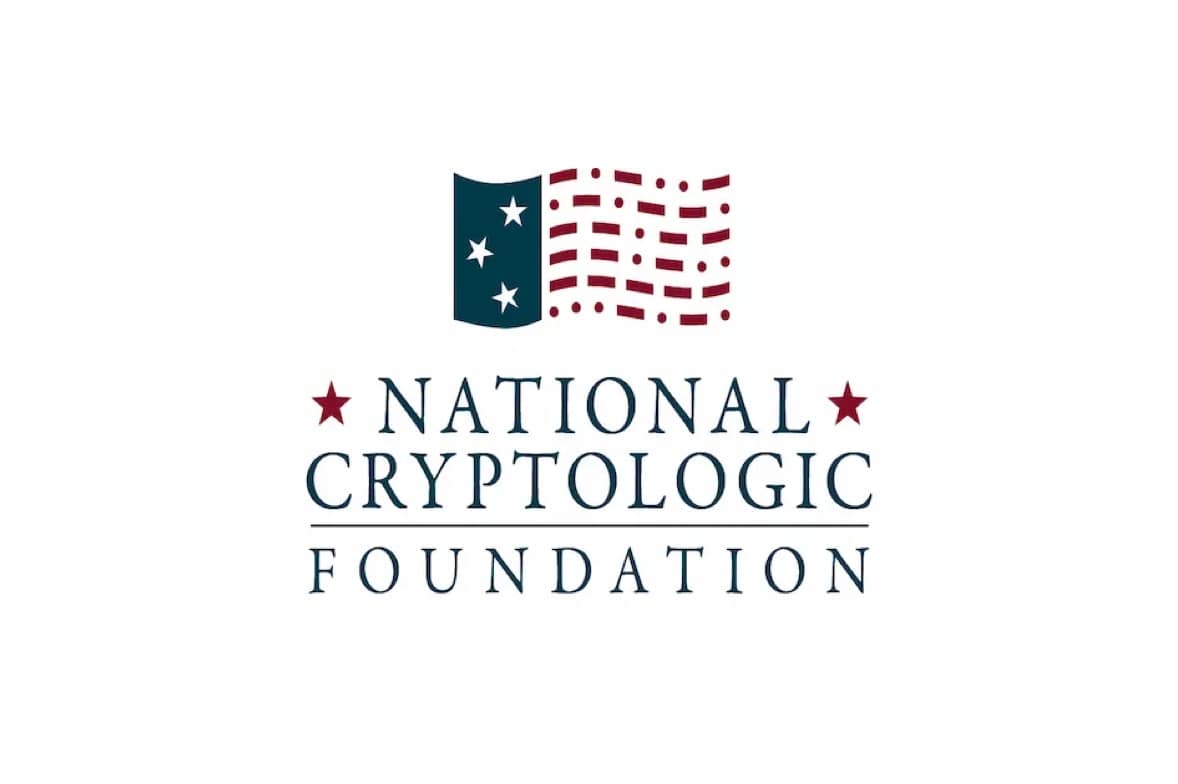
The second logo introduced the iconic red-and-white flag—a stylized Morse code representation of the word “cryptologic.” Used from early 2000s through Fall 2025, this mark honored the Foundation’s connection to national service and its ongoing support of the National Cryptologic Museum. It remained in use as the organization transitioned from museum-focused to mission-focused.
The Counterform “C” Logo (2025)
Revealing what was once hidden.
The 2025 rebrand, led by ADG Creative, introduced a bold new visual identity to signal the NCF’s evolution. At the heart of the mark is a powerful design device: the counterform “C.” A void rather than a shape, it represents the once-hidden world of cryptology—now made accessible, inclusive, and open for collaboration.
Geometric and modern, the logo draws on continuity and connection, with circular forms and a clean sans-serif typeface that nod to the NCF’s role as a unifier across government, industry, and education. The through-line? Progress made visible.
This logo isn’t just a symbol—it’s a statement: the future of cyber is for all of us.