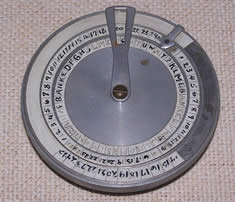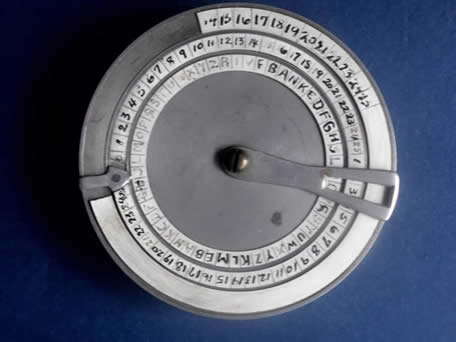



In 2012, Dr. David Kahn advised the Foundation that Riverbank Labs in Geneva, Illinois had two copies of the Wheatstone Cryptograph, (pictured below) a rare pre-WW I-era cipher device used extensively by the British during WW I. The Foundation’s Acquisitions Chairman (AC) contacted both the Director and Curator of Riverbank Labs and negotiated a loan of one of the Wheatstone Cryptographs for the Museum. The AC also discussed pursuing a history partnership with Riverbank Labs and facilitated a meeting with their principals in the near future.
The Wheatstone Cryptograph was invented by Sir Charles Wheatstone (1802-1875), a well-known English scientist. It was evaluated by the U.S. Signal Corps and experimental models of Wheatstone were constructed at Signal Corps Laboratories in Fort Monmouth, New Jersey, but the device was never adopted for use by U.S. forces.
In December 2012, the Acquisitions Chairman also completed the indefinite loan of a rare Wheatstone-Plett cipher device from Riverbank Labs. This specific device is an irregular polyalphabetic substitution system invented in the 1860s by Sir Charles Wheatstone, and improved upon by J. St.Vincent Plett sometime thereafter. The British, French, and Americans all tested the device and none could solve any Wheatstone-Plett cryptograms.
In 1918, the U.S. considered using the Wheatstone-Plett cipher device as a tactical encoder. They submitted it to Riverbank Labs for a final security check where the combined team of William and Elizabeth Friedman solved the device within three hours. The exact provenance of the Wheatstone-Plett device pictured below is unknown at this time.
About Riverbank Labs
During WW I, a variety of war-related research activities occurred at Riverbank Labs, including the decoding and deciphering of enemy messages. Teams of researchers lived and worked at Riverbank, to include Cryptologic Hall of Honor members William and Elizebeth Friedman. The NSA and Riverbank Labs are derived from the same DNA, and the mission of the NSA is a direct descendant of the mission once performed at Riverbank Labs.
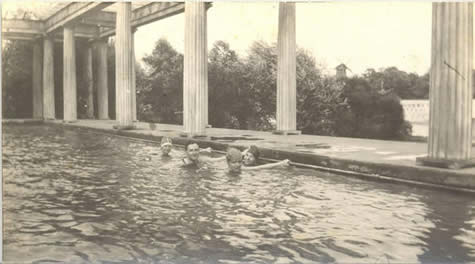
The National Cryptologic Museum’s Library has an extensive collection of photos to include an undated photo of the Friedman’s swimming in the Riverbank Labs pool. A copy of that photo was provided to Riverbank Labs at their request and is also included here. A fascinating detailed history of Riverbank Labs, their association with the Friedmans, and some of the cryptologic work conducted there can be found on the Riverbank Labs website.